WorldAgent - Helping AIs Operate in the Physical World
The world is the next interface. Most AI can't see it.
Language models can write sonnets, debug code, and argue philosophy. Stand one on a street corner and ask it what's happening, and it falls apart. It doesn't know where it is. It doesn't know what's nearby, what's changed since yesterday, or what any of it means to you specifically. It guesses - confidently, fluently, often wrongly.
That gap is the difference between AI that talks about the world and AI that can actually act in it. WorldAgent is built to close it.
From Knowing Words to Knowing Places
Today's AI inherits the internet's worldview: text scraped from somewhere, frozen at some point, divorced from time and place. Ask an LLM about a neighborhood and it will tell you what was written about that neighborhood - not what's true there right now, not what matters to the person standing in it.
WorldAgent inverts the relationship. The model stops being the oracle and becomes the conductor. Behind it sits a spatial intelligence service whose job is to know the physical world the way a great local would: current, contextual, honest about what it doesn't know, and tuned to who's asking.
The model orchestrates. The world answers.
A World of Nested Agents
Here's the move that makes it work: every place has its own agent.
A city has one. So does each neighborhood inside it, each block inside that, each venue on the block, each room inside the venue. Agents inside agents, all the way down to the space immediately around you - and all the way up to the region, the country, the planet.
Each agent is responsible for understanding its own patch of the world. Smaller agents notice the texture and the moment. Larger agents see the pattern and the trend. They talk to each other: children report what's changing, parents notice when something doesn't fit, neighbors compare notes. The system thinks at every scale at once.
When you ask a question, you're not querying a database - you're talking to whichever agent is closest to the thing you care about, with the full chorus of agents around and above it informing the answer. Local knowledge with global awareness, automatically.
It's how the world actually works. A street corner knows things the city doesn't. A city knows things the street corner can't. WorldAgent is the first system designed to honor both.
What Changes When AI Can See Where It Is
When an AI system can ground itself in physical space, a different category of product becomes possible:
- Agents that act on your behalf in the real world without hallucinating the streets.
- Guides that know not just what a place is, but what it means to the person walking into it.
- Systems that distinguish between what is true here and what is true here for you.
- Software that carries uncertainty forward honestly, so the humans and machines downstream can decide how much to trust any given answer.
The shift isn't incremental. It's the difference between an AI that describes the world and one that inhabits it.
How We Build It
Three commitments shape every decision:
Index, don't collect. The world's information belongs where it lives. We reason over it; we don't hoard it. No shadow copies of reality.
Report belief, not truth. Every answer arrives with its confidence and its provenance attached. The system tells you what it believes, how strongly, and why - and admits when it doesn't know.
Local-first, consent-bound. Personal context stays on your device by default. What flows outward does so because you said so.
These aren't features. They're the only way a spatial intelligence layer earns the trust required to be worth using at all.
Proof of Concept: HearHere
The first thing we built on WorldAgent is HearHere - a personalized AI audio guide that narrates the world as you move through it.
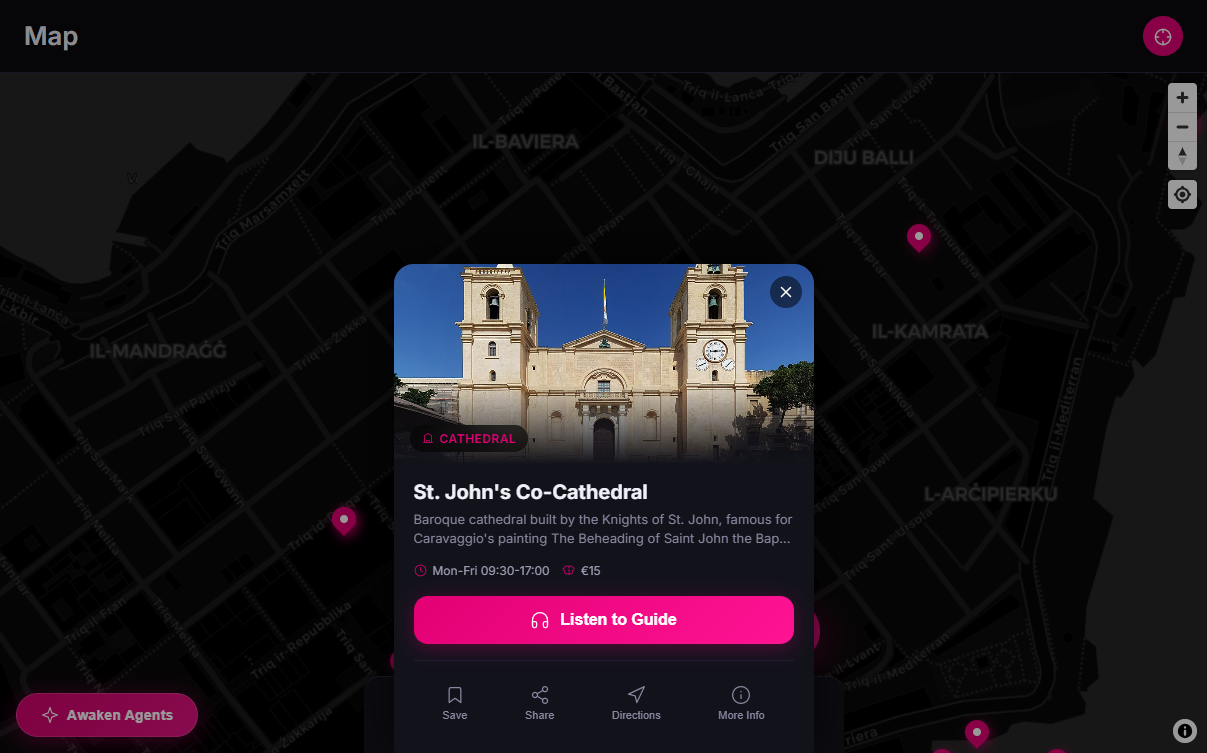
Not pre-recorded tours. Not a playlist of pins. A living layer of spatial intelligence that responds to where you are, what’s around you, what you care about, and what’s actually happening right now. Every fact carries a trust signal. Every moment is shaped for the person in it.
Proof of Concept: HikQR
The second product on the framework is HikQR - trail intelligence delivered through a QR code at the trailhead. Hikers scan, and WorldAgent’s spatial agents answer the questions that matter: what are conditions right now, is this trail right for my group, and how do locals and visitors describe this place differently?
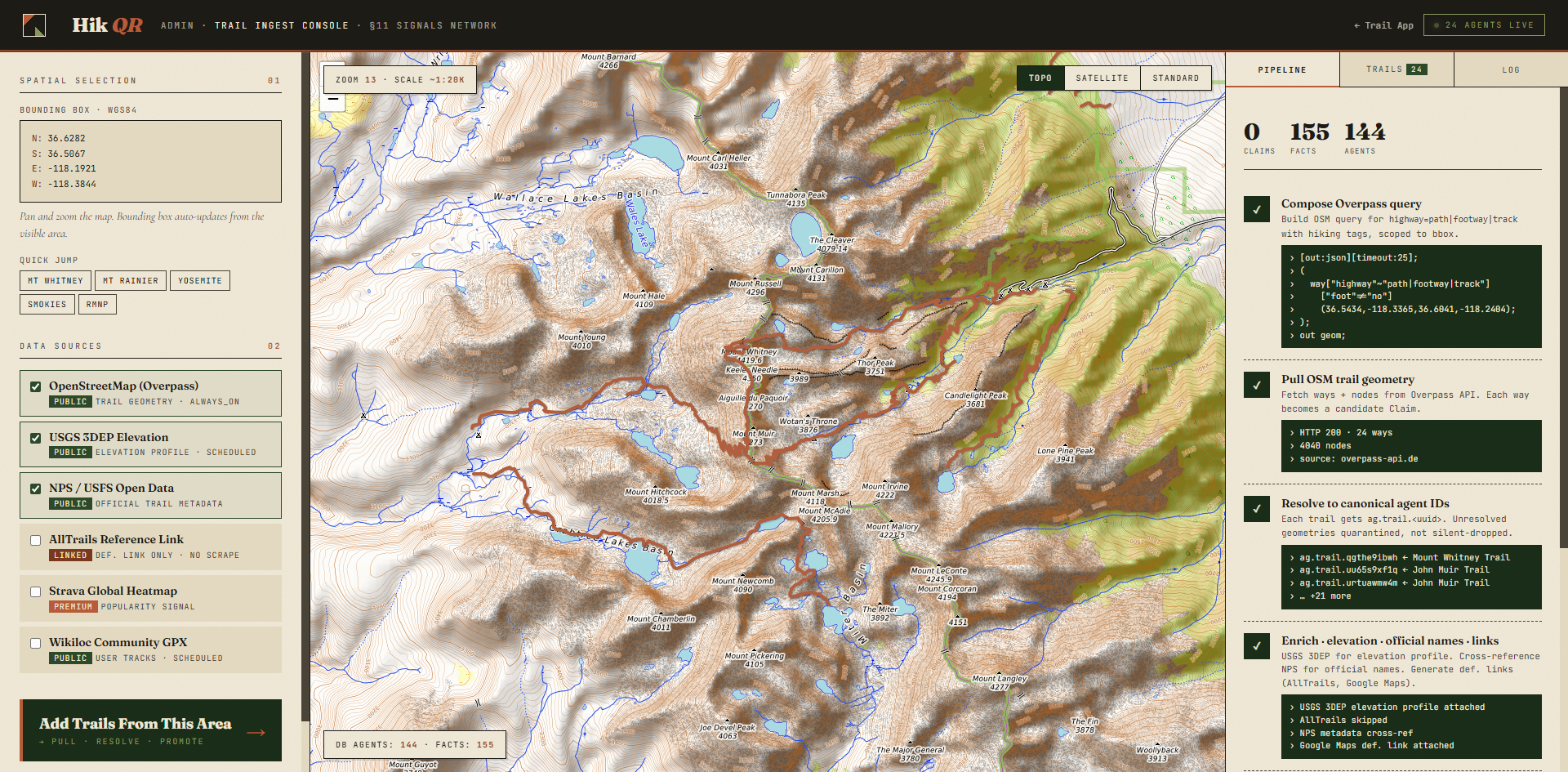
Every answer carries trust scores and provenance. When cohorts disagree about a trail, the system shows the split instead of hiding it. It’s WorldAgent’s architecture made visible: nested agents, cohort conditioning, contestation, and transparent lineage - on the trail, in the moment.
Two proof points, one pattern: a world where every place has an agent, every agent has a voice, and AI finally understands not just language - but location.
Visit WorldAgent.exe.xyz →